Walking Newcastle’s Iconic Bridges
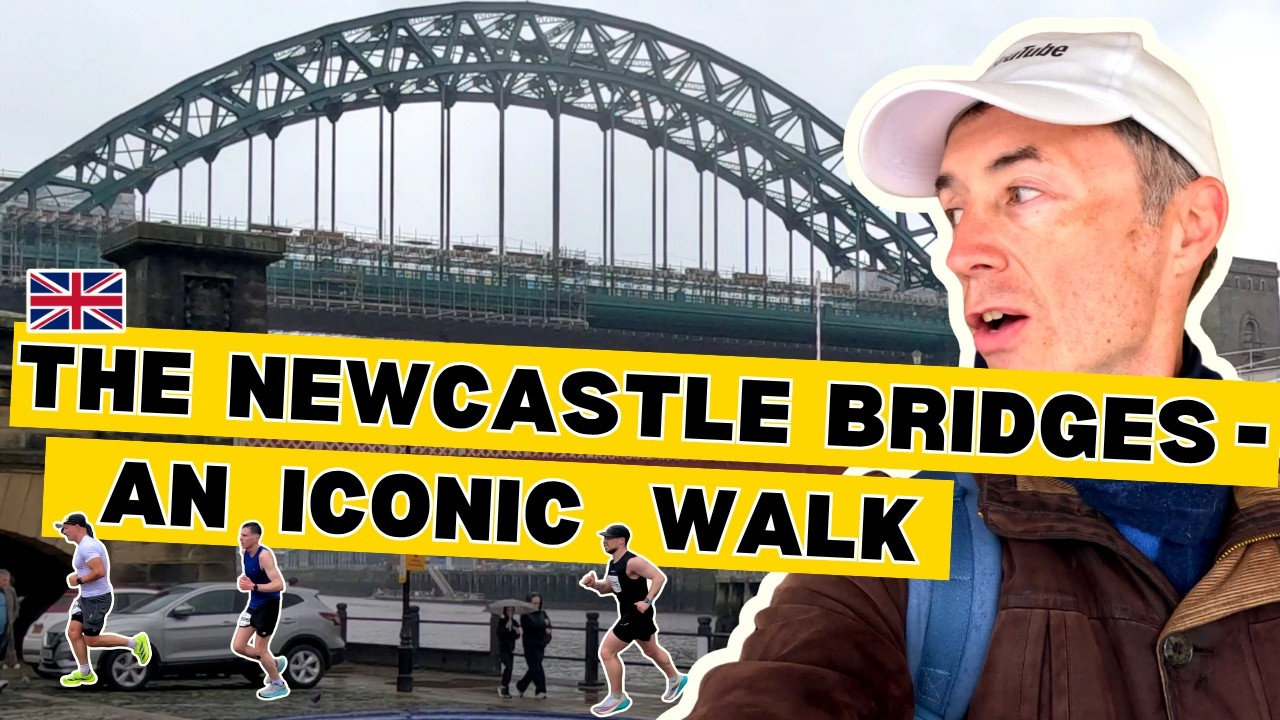
On a bright spring morning I set out to walk every bridge across the Tyne in Newcastle – and realised I had picked marathon day, with the whole riverside given over to runners and an atmosphere I had not planned for. This is the story of that walk: the bridges, the river they cross, and the city stacked up behind them.
If you have time for nothing else, watch the film first. Everything below is the context.
Where I went
Newcastle upon Tyne sits at the north-east corner of England, about three hours by train from London and twenty minutes from the Northumberland coast. The walk follows the Quayside – the riverside promenade on the north bank of the Tyne – crossing between Newcastle and Gateshead over the cluster of bridges that define the gorge. It is a flat, easy loop of two to three miles once you are down at the water, and you can stretch it to half a day with stops for the Sunday market and a coffee.
Why the bridges
No single thing tells the story of Newcastle and Gateshead better than the bridges over the Tyne. They were not built as a set – they went up across more than 150 years, each answering the need of its day – so standing at the river you can read two centuries of engineering in one view: Victorian iron, 1920s steel, and a piece of millennium design that still moves.
What you will see in the video
- The Tyne Bridge (1928) – the green steel arch that is the symbol of the city, built by Dorman Long of Middlesbrough, the same firm behind the Sydney Harbour Bridge.
- The Gateshead Millennium Bridge (2001) – the tilting blinking-eye footbridge that pivots to let boats pass.
- The Swing Bridge (1876) – built by the industrialist William Armstrong so ships could reach his works upriver; it still turns on its own hydraulic machinery, on the site where the Romans once crossed at Pons Aelius.
- The High Level Bridge (1849) – Robert Stephenson’s double-decker, carrying road below and railway above.
- The Quayside itself – old warehouses, the long-running Sunday market, and the Sage and BALTIC arts buildings across the water in Gateshead.
- And, on the day, a marathon – the riverside full of runners and a surprisingly uplifting mood.
Practical notes
- Best time of year: April to October – the Tyne is exposed and the winter wind is no joke.
- Best day: Sunday morning, for the Quayside market that has run in some form for centuries.
- How long: two to four hours at a reasonable pace, with stops.
- Walkability: easy and flat along the water; one short, steep climb if you carry on up to Grey Street and Grainger Town.
- Where to start: Newcastle Central station, about ten minutes from the river.
- What I wish I had known: [Patrick – add the one practical thing from the day, e.g. the marathon road closures or a viewpoint worth the detour.]
A little more history
Up the hill from the river is Grey Street, a long curving sweep of honey-coloured neoclassical buildings often voted one of the finest streets in England, built in the 1830s as part of Richard Grainger’s grand reshaping of the town centre. Newcastle grew on coal and engineering – ‘taking coals to Newcastle’ became a saying for a reason – and the city is named for the medieval ‘new castle’ whose keep still stands near the river, wedged in beside the Victorian railway viaduct.
Related walks
If you enjoyed this one, you might like these from elsewhere in Britain:
- Quayside to Seaside: Walking from North Shields to Whitley Bay — the coastal walk from the Fish Quay to Whitley Bay.
- My Personal Newcastle: Revisiting Places I’ll Never Forget — a slower walk through the city I keep coming back to.
- I Followed a Song from Newcastle — letting a piece of music decide the route.
- I Filmed Two Separate Crimes in Newcastle — a short, surreal one from an ordinary day in the city.
- 11 Nostalgic Seaside Clichés: Hunting Them in Bournemouth — hunting eleven seaside clichés on the south coast.
- A Walk Through Time: Rediscovering the Wendover Canal — a quiet walk along a forgotten canal in the Chilterns.
Stay in touch
New walks land on the channel regularly — the easiest way to follow along is to subscribe on YouTube. The full set of written companions to every film lives in The Journal, and there’s a curated set of the longer pieces on the Featured Films page. If you’ve got an idea for somewhere I should walk next, send it through the Contact page — I read everything.
Patrick Ashton is a UK-based filmmaker walking the overlooked corners of Britain and Europe. More about Patrick →