Quayside to Seaside: Walking from North Shields to Whitley Bay
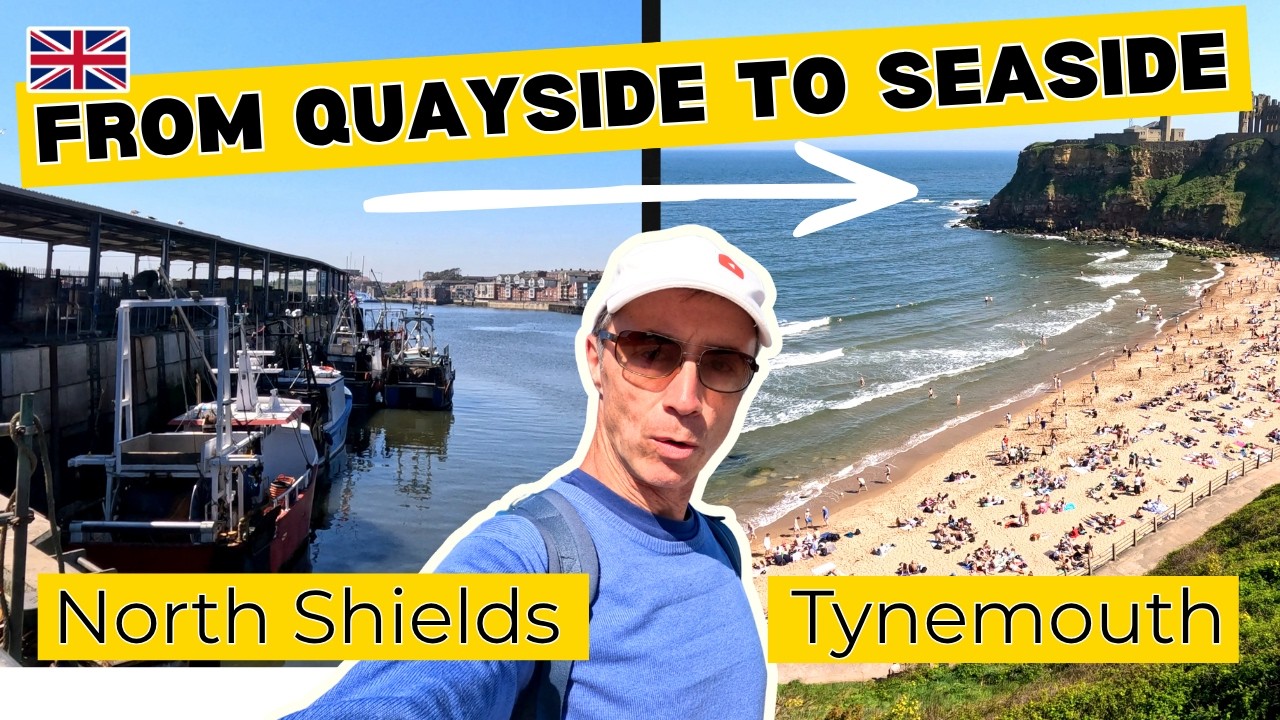
This is definitely a walk of two halves. It starts among the working boats and fish quays of North Shields and ends in the cheerful seaside town of Whitley Bay – a few miles of coast that carry you from the Tyne’s industrial river banks and out along the open coast. Watch the full film below.
The walk
From the Fish Quay at North Shields, the route climbs past the old high and low lights that once guided ships into the Tyne, rounds the headland at Tynemouth – with its ruined priory and castle standing guard over the river mouth – and follows the coast north past a long sweep of sand to Whitley Bay, where the restored Spanish City dome and the lighthouse on St Mary’s Island can be seen at the far end.
Where I went
I started in the town of North Shields, where I enjoyed a coffee at an Elvis-themed cafe. Then I went to a local park where there’s a statue to the town’s most famous former resident. From the Fish Quay at North Shields, I walked along the promenade to Tynemouth, where the ruined priory and castle sit on a sandstone cliff above the river mouth. From there it’s a steady walk north: along Long Sands, through the small fishing cove at Cullercoats, and into Whitley Bay, where the restored Spanish City dome stands over the seafront like a piece of Edwardian theatre that somehow survived.
What you’ll see in the film
- The Fish Quay and the fishing-trawlers at North Shields
- The High and Low Lights — twin lighthouses that welcomed ships into the Tyne
- Tynemouth Priory and Castle on the sandstone headland
- Long Sands — a wide stretch of beach with views back to the mouth of the Tyne
- Cullercoats — a small former fishing town
- St Mary’s Island and its lighthouse, joined to the mainland by a tidal causeway
- The Spanish City dome and the seafront at Whitley Bay
Practical notes
- Best time: spring or early autumn. The light along this coast is at its best, and the seafront is open without the high-summer crowds.
- How long: about three hours at a comfortable pace, plus a stop for lunch.
- Walkability: there are steep steps down to the North Shields fish quay; other than that, the walk is mostly easy, almost entirely on coastal paths and promenade.
- Where to start: I started in the actual town of North Shields up on the cliffs. The Metro will get you there from Newcastle in about twenty minutes, then there’s a ten-minute walk down to the river.
- Where to end: Whitley Bay seafront. The Metro back to Newcastle takes another twenty minutes.
- What I wish I’d known: The fish restaurants of the North Shields Fish Quay are the best place on the route for lunch, but I timed it wrong, and I was there at about 10 am, which was obviously too early for lunch. You could do the walk in reverse and start from Whitley Bay, if that meant arriving at North Shields at lunchtime.
A little history
North Shields grew up around fishing and the river trade, and the Fish Quay still works today. Tynemouth Priory has watched over the mouth of the Tyne for centuries, and Whitley Bay’s seaside heyday left behind exactly the kind of faded, hopeful glamour I can never resist filming.
It’s a walk that holds two moods at once – the grit of a working river and the bright, slightly nostalgic cheer of an English seaside town. Watch the full film above, and tell me which end you’d rather start from.
Related walks
If you enjoyed this one, you might like these from the same patch of the North East — and a quieter walk further south:
- Walking Newcastle’s Iconic Bridges — walking the main bridges over the Tyne.
- My Personal Newcastle: Revisiting Places I’ll Never Forget — a slower, more personal walk through the city.
- I Followed a Song from Newcastle — chasing the places behind a piece of music.
- I Filmed Two Separate Crimes in Newcastle — a short and slightly surreal one from two consecutive days in the city.
Stay in touch
New walks land on the channel regularly — the easiest way to follow along is to subscribe on YouTube. The full set of written companions to every film lives in The Journal, and there’s a curated set of the longer pieces on the Featured Films page. If you’ve got an idea for somewhere I should walk next, send it through the Contact page — I read everything.
Patrick Ashton is a UK-based filmmaker walking the overlooked corners of Britain and Europe. More about Patrick →